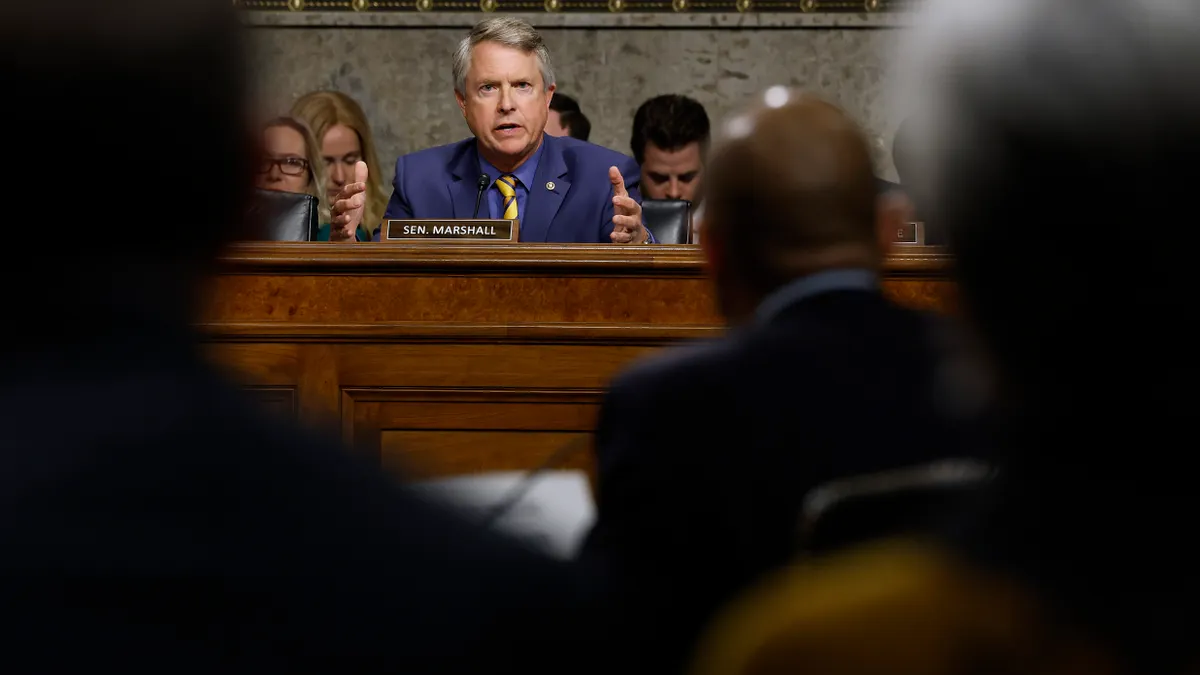
The ‘blue wave’ of Democrat victories in Congress this week washed Republican Sen. Roger Marshall out of office, tapering his support for the Credit Card Competition Act.
Sen. Dick Durbin, the Democrat who has been his partner in the push to pass that bill aimed at lowering card swipe fees for merchants, has already said he’s retiring at the end of this term.
That means that at the start of a new Congress next year, the bill won’t have its two biggest co-sponsors of the past few years in the Senate. That could make a meaningful difference for a piece of legislation that has struggled to win passage since Durbin and Marshall first introduced the legislation in 2022.
The bill, which takes aim at Visa and Mastercard, would force banks that issue credit cards to ensure that an alternative card network, other than those two dominant players, was available to process a transaction. The idea is to create more competition in the card network market in a bid to lower fees that merchants are charged for processing cards.
CCCA proponent Doug Kantor, who has long worked on behalf of merchants as general counsel for the National Association of Convenience Stores, called it “painful” to lose Marshall’s support of the legislation.
But Kantor noted in an interview Wednesday that Marshall has helped win more support of the bill in this congressional session, including from President Donald Trump. Kantor counted nine times that Trump or Vice President JD Vance, a former Senate sponsor of the bill, have publicly called for passage of the legislation. Albeit, much of that public promotion came as part of their failed efforts to see Marshall reelected.
Backers of the bill could still seek to advance it in the final two months of this year, before the two-year congressional session ends and the newly elected senators and representatives arrive, but Kantor didn’t seem hopeful.
He said it depends on how productive the senators and representatives decide to be when they return to Washington. There are still some spending bills that will move this year and they could be vehicles for carrying the bill across the finish line.
The bill has “as good a shot as many other things to move,” offered Kantor, who also sits on the executive committee of the Merchants Payments Coalition.
However, with so many senators and representatives headed for an exit, and a Thanksgiving Day respite from campaigning just a few weeks away, it’s easy to see them coasting toward the year-end break.
When asked about future support for the bill, a spokesperson for Durbin pointed to Sen. Peter Welch, a Democrat from Vermont who has been a Senate sponsor of the legislation, and was also in his prior role as a House representative. Durbin this month handed the torch to Welch, according to a report from the political publication PunchBowl News.
The bill benefited from having a Republican leaning in alongside a Democrat, with Marshall throwing his weight behind Durbin’s longtime fight against the top credit card networks. The legislation also had bipartisan backing in the House, where Republican Rep. Lance Good of Texas and Democratic Rep. Zoe Lofgren of California have supported the bill. Both hung onto their seats.
As far as finding a new Senate Republican to champion the bill, Kantor suggested the existing sponsors would fill that need. With Sen. Cynthia Lummis retiring, that would seem to leave only Sen. Bernie Moreno of Ohio, a state that just returned Democrat Sherrod Brown to the chamber in the latest election.
Opponents of the bill have no doubt that the merchant advocates of the legislation will keep up their years-long campaign to pass the bill. The Electronic Payments Coalition is one of the groups that has battled the bill. They’re bracing for the ongoing clash.
“Our work will continue to focus on educating Americans and policymakers about the real-world consequences of proposed credit card legislation, including its potential impact on small business and consumer access to credit, community financial institutions, data security protections, and cash back and other rewards programs,” EPC Executive Chairman Richard Hunt told members of that group in an emailed note Wednesday morning.
Hunt noted CCCA proponents, including at the National Restaurant Association, are casting the legislation as an “affordability” issue, a theme that helped Democrats win seats across the country. Backers of the bill argue that merchants paying higher fees means prices go up for consumers.
If that becomes the central thrust, there’s always the possibility that the new Congress moves right past paying attention to card fees paid by merchants, and focuses instead on interest rates paid by card holding consumers.
That might play into the hands of Sens. Bernie Sanders, an Independent from Vermont, and Josh Hawley, a Republican from Missouri, who will remain in the next Congress. Last year, they introduced a bill to cap card interest rates at 10% and will presumably keep pushing for passage.
It’s a bill that has also won backing from Trump and might have improved chances with more Democrats on Capitol Hill.