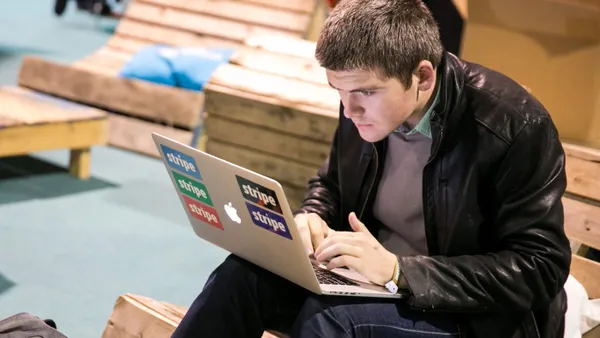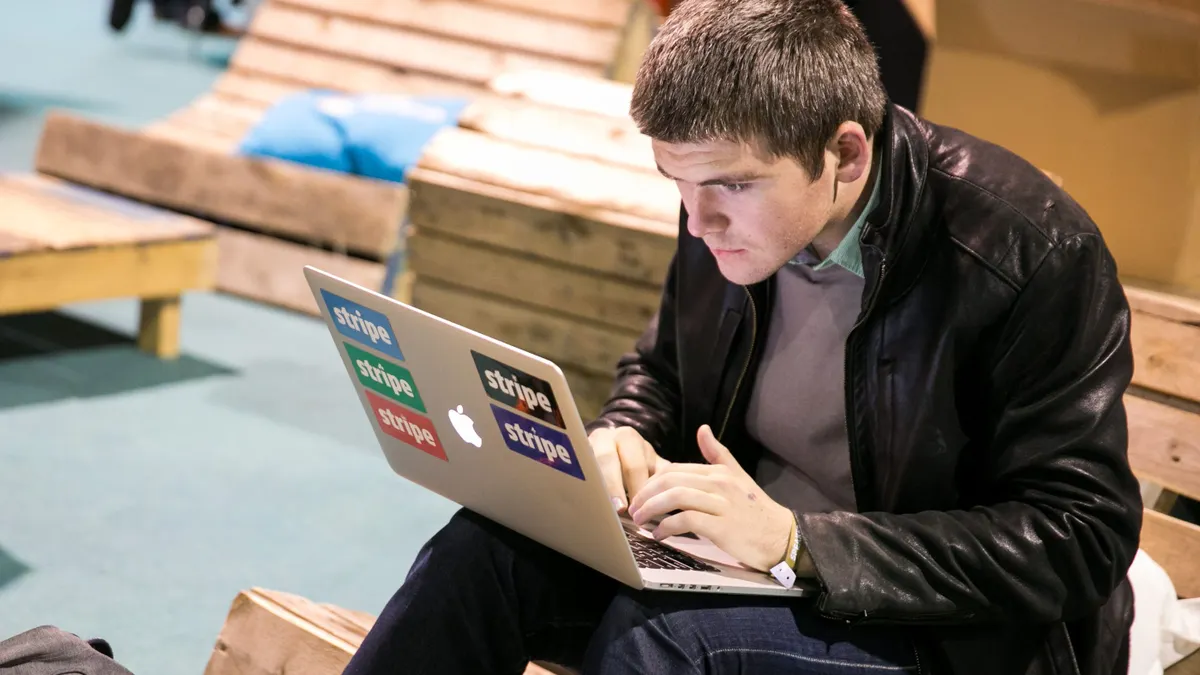
Digital payments processor Stripe charted a significant increase in agentic commerce, starting last month, the company’s president, John Collison, said this week.
During the Cheeky Pint podcast that he hosts, Collison described an increase in the bot-driven commerce on Monday as he conversed with Meta Platforms CEO Mark Zuckerberg and that company’s chief AI officer, Alexandr Wang. Collison alluded to Stripe statistics showing increased agentic activity happening in September, in the wake of its Stripe Sessions marketing event in May.
“It's very interesting to look at the agentic commerce stats at Stripe because we started developing all this stuff and we had a whole bunch of announcements at Sessions back in May, and then it only, as of September, basically started going vertical,” Collison told Zuckerberg and Wang.
Collison’s agentic commerce disclosure surfaced as the three talked about Meta’s development of the AI personal assistant Muse and its abilities to buy merchandise on command, among other tasks.
Collison didn’t provide any specific figures related to agentic commerce activity at Stripe, which processes payments for businesses globally.
The notion of agentic commerce — in which AI agents help consumers shop and order goods and services online — has gained traction this year, while agentic payments — where the bots actually pay for purchases — has trailed behind as a more distant possibility. Payments players have been wrestling with payments aspects, like liability for chargebacks.
During the conversation, Zuckerberg acknowledged that Meta has spent as much as $200 billion on developing the company’s artificial intelligence capabilities and has been lining up the computing capacity for the AI since about 2023. Last year, Meta named Wang as its first AI chief and he has spearheaded the effort.
During the podcast, Collison made a pitch for Stripe’s AI services offered through OpenRouter, a business that Stripe paid $7.5 billion to purchase in August. OpenRouter acts as a gateway for access to a variety of AI models, including Muse and Meta’s latest upgrade, Wonder.
John Collison and his older brother Patrick, who is Stripe’s CEO, co-founded the company in 2010. The business has dual headquarters in Dublin and South San Francisco, and was valued at about $160 billion earlier this year when the company raised money from existing shareholders and employees.
Online retail behemoth Amazon recently banned Meta’s Muse agent from shopping on its website, saying it would breach the terms of conditions for customers shopping on the website.
Without reference to Amazon specifically, Zuckerberg suggested that companies that bar the AI assistant will regret it. “We have way more businesses that are calling us asking to integrate deeply, and very few really who have tried to block it,” Zuckerberg said. “My guess is that the ones that try to block it, it will end up not being the right strategic thing for them. But we'll see. This will kind of play out over time.”
Zuckerberg, whose approximately $255 billion net worth makes him one of the richest people in the world, shared an example of how he and his three-year-old daughter bounce baking ideas off his Muse agent so it can then buy the ingredients they need via the digital delivery service Instacart for their weekend baking.
“I'll do some baking in order to make Aurelia happy, and so we've gotten into this really cute routine” where the not-yet-available Muse voice mode “knows which one is me and it knows which one is not me based on that, and throughout the week we're talking about what we'll want to bake that weekend,” Zuckerberg explained.
Wang has been using his AI agent to purchase “ increasingly obscure teas from increasingly obscure vendors” around the world, he said.
“We have been very excited about agent-to-commerce for a long time,” he said, describing how “no one needs all that friction in their life from the actual buying stage.”
Collison added: “It really feels like computer use was the last big unlock that we needed to make it happen, because now you can ask your Muse to buy anything, more or less, and it'll just figure it out with computer use.”
Muse is one of the first AI services where “people are fully delegating purchases to the agents,” Wang said during the podcast. “One part of the value prop for the user is just reduced friction. Like, hey, I don't feel like clicking on all these websites and doing all this research to try to find the exact products.”
Collison, who like his brother Patrick is estimated to have a net worth of $17.5 billion, shares the vision of bot-shopping where consumers will increasingly rely on agents to buy goods and services.