Dive Brief:
- Shopping is the most common activity for Meta Platforms’ new Muse personal artificial intelligence agent, with an average purchase size of $200, CEO Mark Zuckerberg said Wednesday during a conference call to report quarterly income. About 25% of Muse users task it with shopping, including travel planning, he said. Digital payments processor Stripe handles some payments.
- In the first week of the Muse agent’s release last month, Meta “had to work with Stripe to raise credit limits, since the volumes were above what any of us expected,” Zuckerberg said, without offering any specifics about agentic transactions or payments. About 10 million people have signed up for a Muse agent, in the U.S. and Canada, the initial two markets, he said. Meta uses Stripe’s Link digital wallet as the Muse payment method.
- Beyond agentic shopping, users’ directions to increase their “personal productivity” and connecting Muse to email and calendars are the next most widely used tasks for the service, Zuckerberg said.
Dive Insight:
Meta’s third-quarter earnings report Wednesday was its first since the Sept. 8 debut of the personal AI agent. Meta describes the digital agent as one that requires no technical experience and “no learning curve.”
Stripe charted a significant increase in agentic commerce, starting last month, the company’s president, John Collison, said last week, during a podcast he hosts. He described the increase in the bot-driven commerce as he conversed with Zuckerberg, saying the Stripe agentic activity “started going vertical,” in September. Collison’s brother Patrick Collison, who is Stripe’s CEO, sits on Meta’s board of directors.
Muse, along with personal agents like Instinct, and the open source agent OpenClaw, are viewed by some in the payments industry as the likeliest gateways for agentic commerce to expand into agent-driven consumer transactions.
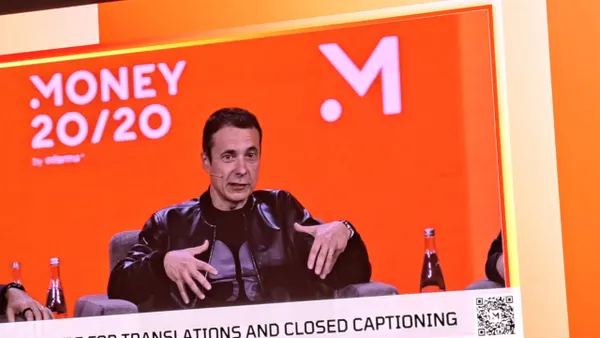
The topic of AI-driven commerce – including agentic transactions and whether a “human in the loop” model will ever yield to fully machine-driven payments – was a major topic of discussion at the annual Money20/20 financial technology conference this week in Las Vegas.
Agentic spending remains far from ready for mass public use, with multiple parties in the retail ecosystem still needing to sort out a variety of issues, including liability, Early Warning Services CEO Cameron Fowler said Monday in an interview.
EWS is a consortium owned by seven of the largest U.S. banks, several of which have moved to block access by AI agents such as Muse to their customers’ accounts. JPMorgan Chase, the largest U.S. bank, was among the first to do so, with CEO Jamie Dimon discussing the issue last week on the company’s quarterly earnings call.
“Turning that engine onto spending our money for us is just such a wildly different proposition, and almost none of the customer protections that you would expect to see are in place,” said Fowler, a former banking executive with Montreal-based BMO Financial Group.
Muse is available only in the U.S. and Canada as costs for the computing infrastructure powering the service remain too cost-prohibitive for a wider global release, Zuckerberg said.
“If we actually did roll it out more broadly, then you would expect that (user) number to be significantly larger than what we're seeing today,” he said. “But then on the flip side, we actually have to go do the work to bring the efficiency in line to make that make sense, and so that's a big part of it that we need to do.”
Meta will work to make money from Muse sooner than its “normal playbook” for products, Zuckerberg said, owing to the operating costs of computing infrastructure and the size of the opportunity the company sees for personal agents.
Meta aims to connect Muse agents with billions of people and evolve it into a broader Muse network that includes businesses interacting with their own agents, the billionaire founder and CEO said. Meta is the parent company of social media sites Instagram and Facebook.