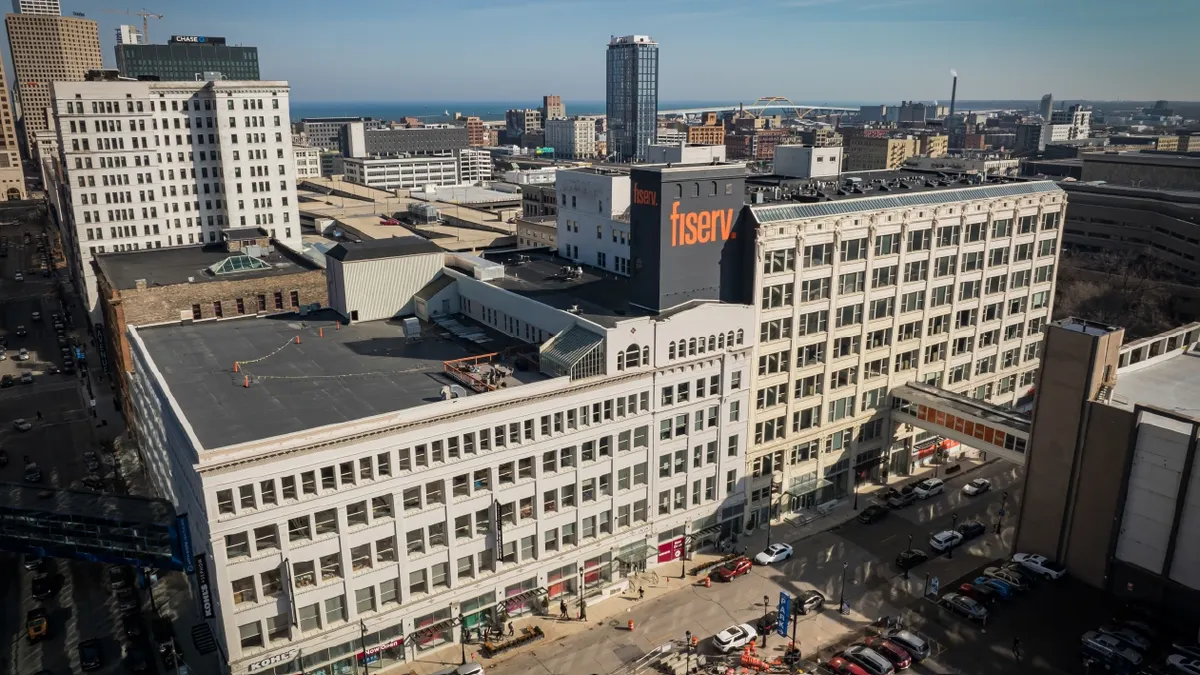
Fiserv is now targeting $1 billion in savings, up from $500 million, as its new CEO seeks to transform the business into one generating more revenue and profits.
In reporting its third-quarter earnings results Tuesday, CEO Takis Georgakopoulos said that a previously announced review of the company’s operations and technology had allowed it to identify cost-cutting opportunities and areas where it could work with artificial intelligence partners.
To date, the company has already eliminated 3,000 contractors and employees under the plan, including by shaving its management layers, he said. He didn’t distinguish between contractors and workers.
“We've analyzed every non-core asset that we have,” Georgakopoulos said in answering an analyst’s question on the webcast. “We looked for assets that have either economic challenges or technology challenges or overlaps with other things that we do, or are not consistent with our long-term vision.”
The company has talked with major banks about the sale of one of its debit networks, according to earlier reports, including by the Wall Street Journal.
Given those non-core assets are eating up capital and resources, the company has taken the approach that it needs to “rationalize,” or cut back in those areas for the benefit of the company’s long-term prospects, he explained.
For the third-quarter, Fiserv reported a net loss of nearly $6 billion, including a significant noncash goodwill impairment of $6.45 billion related to its restructuring, as revenue slipped 1% to $5.2 billion, according to a Tuesday earnings press release.
Fiserv Chief Financial Officer Paul Todd referred to the cost-cutting plan as having $1 billion in “savings opportunities” during the webcast, saying on the webcast that some of the benefits wouldn’t start to show up until next year or later.
Fiserv has also begun having conversations with interested buyers for some parts of the business that aren’t central to its operations, he said.
“Through our portfolio review, we have identified a number of businesses and activities that are not core to our go-forward strategy and where we may pursue alternative ownership arrangements,” Georgakopoulos said on a webcast with analysts who follow the company. “We are in conversations with multiple parties, with [non-disclosure agreements] and processes in place, but it is too early to estimate the proceeds to Fiserv from these efforts.”
Georgakopoulos has been seeking to restructure the Milwaukee-based company since he was named CEO in June. He was appointed after the exit of Mike Lyons, who served in the post for only about one year after the exit last year of Frank Bisignano, who left to head the Social Security Administration.
Since Bisignano’s exit, the company has struggled with fallout from a lack of growth in its once high-growth Clover point-of-sale business. Shareholders have sued over that unit not satisfying past growth objectives.
One new way in which Georgakopoulos will now try to right the business is by selling Clover’s services to larger companies. He described Tuesday how in the past Clover, which is focused on small and midsize businesses, lost clients after they grew larger.
“This expansion enables Clover to go beyond small businesses to sell larger, more complex merchants with multiple locations, bridging a key gap in Clover's current offering,” Georgakopoulos said on the webcast.