As agentic commerce gains wider use, the payments industry is pondering how artificial intelligence may herald a change in payment methods.
Bots won’t be bothered by traditional payment frictions that torment humans, such as confusing checkout flows, account creation forms, password setup or poor user interfaces.
An agent will focus on payment parameters the human consumer has provided, such as maximizing discounts or card-issuer rewards, and select the payment method it views as offering attributes that align with those guidelines, said Brian Dammeir, head of payments and financial management at Plaid.
The San Francisco-based financial data aggregator transfers consumer account information between banks and fintechs.
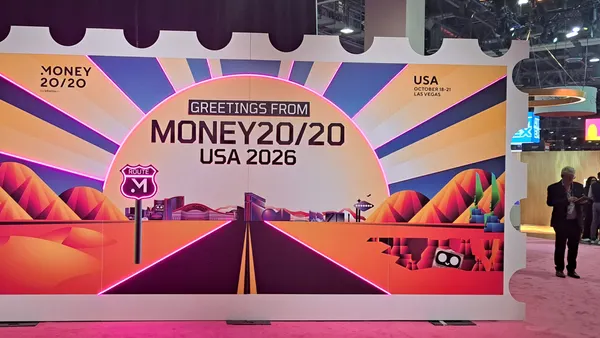
As a result, it’s likely that banks, card issuers, merchants and the card networks will see shifts relative to how people pay today, he said. Dammeir discussed Plaid’s payments business and agentic transactions during an Oct. 19 interview on the sidelines of the Money20/20 financial technology conference in Las Vegas.
Editor’s note: This interview has been edited for clarity and brevity.
PAYMENTS DIVE: How do you see the payments ecosystem changing if agents, and not humans, select a payment method?

BRIAN DAMMEIR: I think the main thing folks opine on, or think about, and we think a lot about this, is in an agentic world will there be different consumer preferences around payments? If, at the end of the day, you’re permissioning something to an agent, and the agent's incentive is to take the most efficient, or most effective, route to pay for the consumer they’re acting on behalf of, you could certainly see a world in which, for example, bank payments are adopted more broadly, and you could see the mix of payment methods changing in this world. That being said, I think that's all going to depend on the consumer experience and what each of those things looks like to the consumer and which appeals to them more.
Does that lead to a new world of incentives by companies to lure a bot to a particular payment option?
The opportunity here for any network payment method player is that there’s going to be a world now in which agents are talking to agents and making a decision, and representing all parties. I’ll have an agent that represents me as, let’s say, someone buying a shirt. There’s an agent on the other side representing the merchant in their best interest. Whoever is able to create technologies that allows those agents to make the best decision, hypothetically, is going to do better in the end. Now, does that then end up being like the card-centric world, the bank-payment world, or various other payment methods? Only time will tell. But that is the opportunity, right?
Will this payment decision be made at the consumer level, with humans setting those parameters, maybe choosing travel rewards or highest cash-back offers? Or will these selections rest with the agents?
The consumer really does drive behavior. Now, we as payments experts are going to know many of the idiosyncrasies of what’s going on underneath. In the card world, it’s interchange (cost), and maybe there will be these agentic standards and how they’re all talking to each other. Most consumers will not have knowledge of that, but they will understand the value they’re being given. If I tell my agent, I love flying, I love travel, I want to optimize for what’s going to give me the best there. Or maybe I’m someone who just optimizes for cash in my pocket, and I want simplicity. That’s not too dissimilar from the world today, but agents are going to be able to work through that question much more effectively than a consumer has been able to. The agent can be an expert, but the consumer doesn’t have to be. So that is what’s going to shift behavior.
What do you see in terms of agentic payments today?
Most (agents) generally have one or two wallets available. It’s early days. There’s a lot of just initial, ‘Hey, we need to get started, we need some payment methods.’ But I expect a year from now, it’s going to look very different than it does right now. It's going to be a lot more options, including, in our view, paying by bank in certain contexts.