Dive Brief:
- Buy now, pay later company Affirm has options for dropping less profitable lending; asking some consumers for down payments; and requiring more financial information from consumers if they become more financially stressed in a potential U.S. economic downturn, Chief Financial Officer Rob O'Hare said Tuesday.
- His comments were hypothetical, but if cash-strapped consumers staring down skyrocketing gasoline prices pull back on spending, the company could tighten lending standards and stop offering the loans with the lowest profit margins to increase overall profitability, he said during a fireside chat with a Rothschild analyst.
- "Most of our profitability is coming from the middle and upper part of our credit spectrum, so we would take loans that were previously break-even out of the system and find a new break-even point," O'Hare said.
Dive Insight:
The U.S. economy has encountered some bumps recently. On the employment front, it lost 92,000 jobs in February, according to the Bureau of Labor Statistics. Also, U.S. airstrikes on Iran that began Feb. 28 have disrupted global oil markets and pushed up energy prices. A gallon of regular unleaded gasoline cost $3.88 per gallon on Thursday, up by about a third from $2.93 per gallon a month prior, according to AAA.
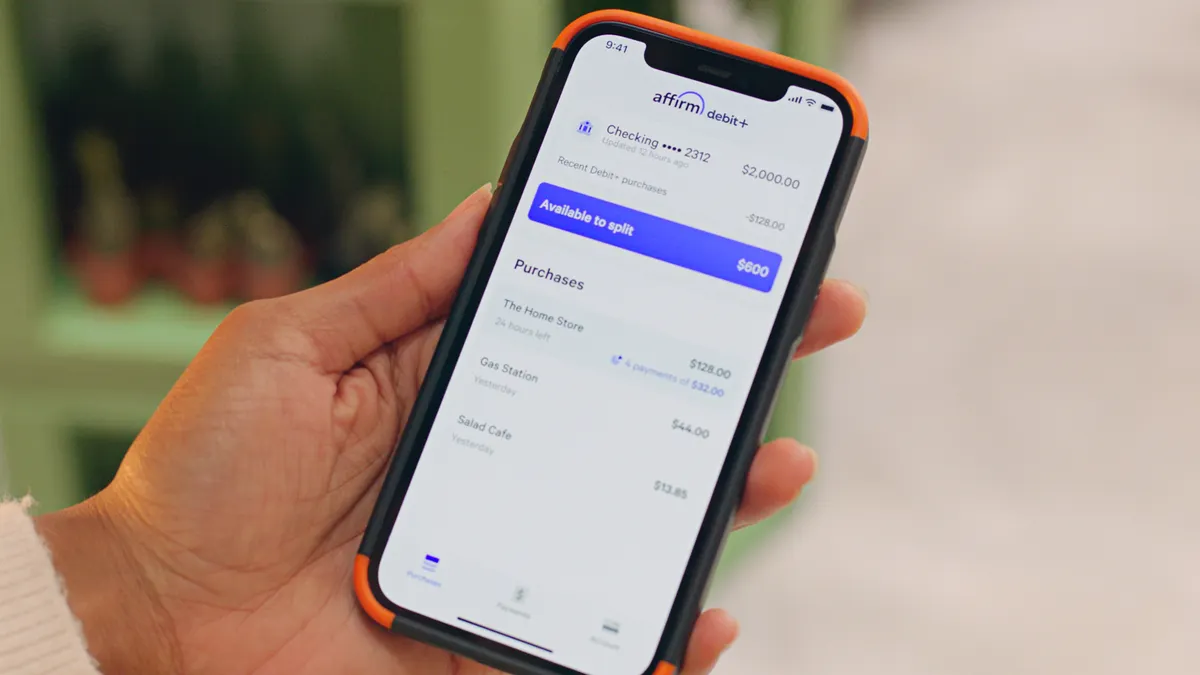
San Francisco-based Affirm provides buy now, pay later financing options to consumers through merchants and online retailers such as Target and Amazon.
The CFO stressed that the company has not seen any softening in consumer demand, however, if it must make changes, Affirm has the flexibility to alter its lending standards because it does its own underwriting.
Requiring down payments in some cases “helps us take risk out of the system if the consumer has some skin in the game,” O'Hare said.
Asking consumers for more financial information up front and adjusting the minimum credit score needed to qualify for an Affirm loan are also options the CFO said the company could consider.
“If we can get more information about the consumer's financial health, that can allow us to put our best foot forward and make sure that we maximize conversion for the merchant partner,” O'Hare said.
He didn't say what kind of loans the BNPL player might cut back on if it were to reduce certain types of lending. Affirm provides short-term installment loans, some of which are interest free, and long-term loans that require consumers to pay interest.
An Affirm spokesperson declined to provide more details on possible options, but said in an email that underwriting every transaction gives the company a “structural advantage.”
“Affirm has all the tools necessary to thrive in virtually any macroeconomic environment,” the spokesperson said in an emailed statement.
The traditional pay-in-four installment loans that do not accrue interest and are repaid over the course of four weeks are the BNPL industry's signature product, but buy now, pay later companies have increasingly offered longer term loans repaid over several months, with interest.
Correction: The story has been updated to make clear that Affirm is not currently considering changes to its lending practices.